
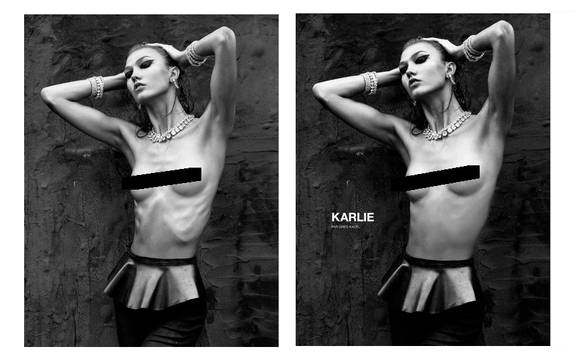
 Real live actual women barely stand a chance. It seems when inches are not being shaved off in Photoshop, they’re being added on. Is it any wonder that our body ideals are skewed when the photographs we’re bombarded with on the regular are not actually photographs but are more like photo-hybrid painting things that create an unattainable concept of feminine beauty?
Leah Hardy, a former editor of Cosmopolitan, wrote an expose copping to what she called “reverse photoshopping.” With ”reverse photoshopping,” she and her cohorts would regularly hide the terrifying side effects of malnourishment in models and starlets with airbrushing. Sallow cheeks? Sunken eyes? Make that full cheeks and a sly twinkle. Protruding rib cage? Smooth that out and knock her breasts up a size while we’re at it. Don’t mess with the 22 inch waist or slender ankles,but for the love of all that is healthy, let’s add some meat to her derrière.
In Hardy’s own words –
“When editing Cosmopolitan magazine, I faced the dilemma of what to do with models who were, frankly, frighteningly thin. [One woman was] so frail that even the teeny dresses, designed for catwalk models, had to be pinned to fit her, but her body was covered with the dark downy hair that is the sure-fire giveaway of anorexia.
Naturally, thanks to the wonders of digital retouching, not a trace of any of these problems appeared on the pages of the magazine. At the time, when we pored over the raw images, creating the appearance of smooth flesh over protruding ribs, softening the look of collarbones that stuck out like coat hangers, adding curves to flat bottoms and cleavage to pigeon chests, we felt we were doing the right thing.
Our magazine was all about sexiness, glamour and curves. We knew our readers would be repelled by these grotesquely skinny women, and we also felt they were bad role models and it would be irresponsible to show them as they really were.”
Hardy goes on to explain the widely woven web that’s brought the fashion industry to this dangerous place — the teeny tiny sample sizes, the models purging between being cast and showing up on set, the extreme expense that would be caused by calling off a photoshoot simply because its subject arrived looking like she might be at Death’s door. Instead, Hardy admits she and her counterparts continue to go with the caustic flow, using models as sketches upon which they’ve drawn beauty ideals that simply don’t exist, neither for the women in the pictures, or the women looking at them. …continue reading…